 (626) 286-0360
 Airsoft
 Fishing
 Air Gun
 TCG
TCG Events

What Does FPS Mean in Airsoft?
If you've spent any time looking at different types of Airsoft guns, you've seen FPS listed in almost every product description. It's one of the most frequently cited specs in Airsoft, and one of the most frequently misunderstood. Here's what FPS actually means, why it matters, and what you need to know before you hit the Airsoft field.
FPS stands for Feet Per Second, a measurement of the muzzle velocity of an Airsoft BB as it exits the barrel. A gun shooting at 350 FPS fires BBs that travel 350 feet in one second. It's measured using a chronograph (commonly called a "chrono"), a device that clocks the speed of the projectile (BB) as it passes through. Most fields require you to chrono your gun before play to confirm you're within their specific FPS limit to ensure player safety.
Outside North America, players and manufacturers often use MPS (Meters Per Second) instead. The conversion is straightforward: 1 FPS equals approximately 0.3048 MPS, which is why 328 FPS comes up so often in international discussions; it equals exactly 100 MPS, or 1 joule of energy with a 0.20g BB.
FPS vs. Joules: What's the Difference?
This is where many players get tripped up. FPS measures speed, not power. The actual impact force of a BB depends on both its speed and its weight, which is why joules are considered a more accurate indicator of an Airsoft gun's power output and potential to cause injury.
The formula is straightforward physics:
Kinetic Energy (in joules) = 0.5 � mass (in kg) � velocity� (in MPS)
As a practical example, a gun shooting at 400 FPS with a 0.20g BB produces approximately 1.49 joules of energy. Switch to a 0.25g BB and the FPS will drop, but the kinetic energy stays roughly the same, because the heavier BB carries that energy further. This measurement is vital when asking if Airsoft hurts, as higher joule ratings at close range naturally increase the sting of an impact.
This is also why most fields chrono guns with a standard 0.20g BB; it keeps comparisons consistent across different setups. It's also why many fields are moving toward joule caps rather than raw FPS limits. A heavier BB fired at lower FPS can carry more impact energy than a lighter BB fired faster, and joule limits account for that in a way that FPS alone cannot.
Typical FPS Ranges by Gun Type
These are approximate stock figures measured with 0.20g BBs for various types of Airsoft guns:
- Pistols: 160-350 FPS
- AEGs (Automatic Electric Guns): 300-400 FPS
- DMRs (Designated Marksman Rifles) / semi-auto builds: 400-450 FPS
- Bolt-action sniper rifles: 450-550 FPS
Higher-end stock guns often land near the top of their category's range. Budget spring pistols tend to fall on the lower end. Upgraded internals can push any platform higher, though that always needs to be checked against your field's limits before play.
Field FPS Limits: What You Need to Know
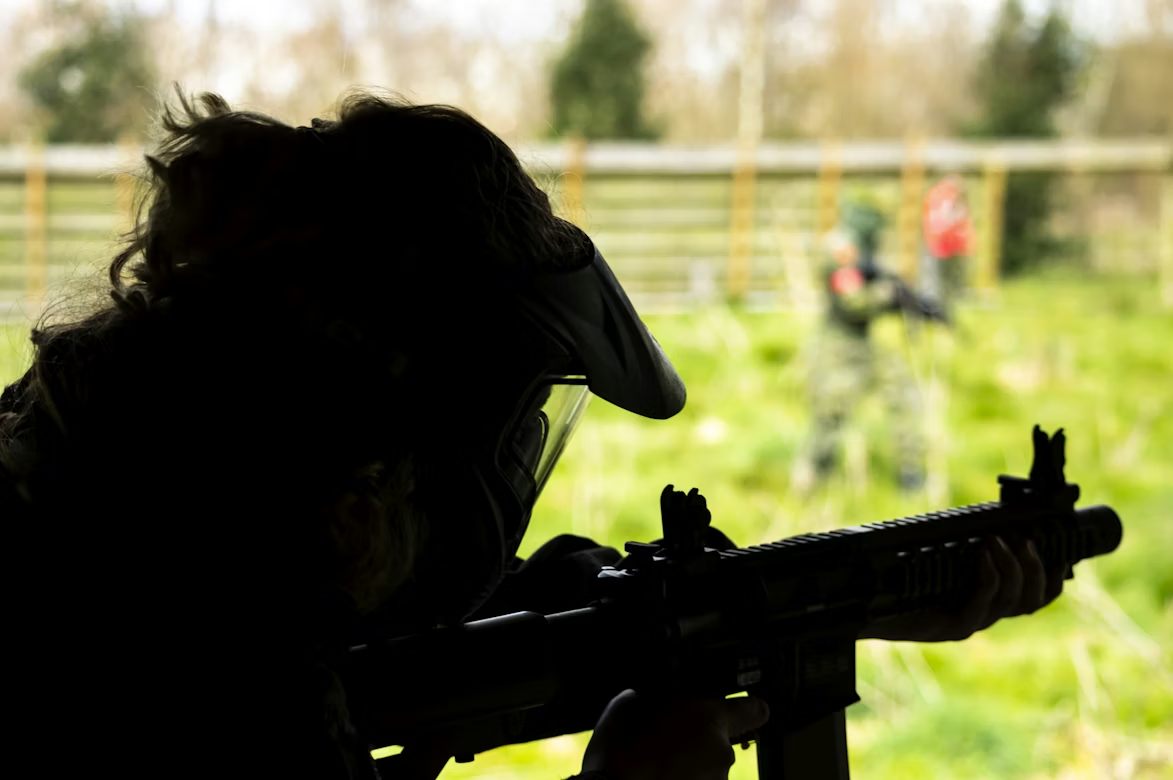
Fields set FPS limits for one reason: player safety. A BB traveling faster hits harder, and the appropriate limit depends on how close players typically are to each other. That's why limits vary by game type, platform, and engagement distance.
CQB / Indoor
CQB (Close Quarters Battle) arenas typically cap velocity at around 350 FPS.1 Some fields set the limit lower, at 300 FPS, depending on how tight the layout is. At close range, even a modest speed difference can significantly alter the impact, so these limits exist to protect players who may be just a few feet apart.
Outdoor Standard
Most outdoor fields set a limit of around 400 FPS for AEGs, with snipers allowed up to 500 FPS paired with a minimum engagement distance.2 Some North American outdoor fields extend that allowance for bolt-action snipers to 550 FPS, but only with strict MED requirements in place.
Sniper Rifles and Minimum Engagement Distances (MEDs)
Higher FPS is often permitted for bolt-action sniper rifles specifically because snipers are expected to engage at distance, not up close. The tradeoff is an MED, a minimum distance within which the sniper cannot shoot. A common MED for high-powered sniper rifles is 60-100 feet, preventing close-range shots that could cause injury at elevated velocities. Many outdoor fields permit sniper rifles to operate at up to 500 FPS, provided the player adheres to minimum engagement distances, typically around 100 feet.
It's worth repeating: check your specific field's rules before every event. Limits vary, and showing up with a gun that doesn't pass chrono means you're sitting out.
Why FPS Matters for Your Gameplay
Higher FPS means BBs reach their target faster and experience slightly less drop over distance. But it doesn't automatically translate to better accuracy or effective range - and this is one of the most common misconceptions in Airsoft.
The hop-up system, which applies backspin to each BB and generates aerodynamic lift, plays a much bigger role in real-world range than FPS does. A gun tuned to 330-380 FPS with a well-adjusted hop-up and quality BBs will consistently outperform a poorly tuned 420 FPS gun at distance. Chasing maximum FPS at the expense of hop-up tuning and BB quality is a classic beginner mistake that leads to frustrating results on the field.
FPS also has a direct relationship with BB weight. Switching to heavier ammo will lower your FPS reading, but heavier BBs are more stable in flight, more wind-resistant, and better suited for range. Understanding that trade-off is part of getting the most out of any setup.
Shop Airsoft Guns at Evike.com and Find the FPS Right for You
Whether you're gearing up for CQB, running an AEG on an outdoor field, or building out a long-range sniper loadout, the right FPS for your setup depends on where you're playing and what role you're filling. Browse different Airsoft guns at Evike.com across every platform and FPS range, from CQB-ready pistols and SMGs to full-length AEGs and bolt-action sniper rifles built for distance.
Sources
- Wikipedia. Airsoft. https://en.wikipedia.org/wiki/Airsoft
- Airsoft Society. Average FPS of Airsoft Fields. https://www.airsoftsociety.com/threads/average-fps-of-airsoft-fields.148878/